


5-Step Food Prep For A Lean, Healthy Body
- Aug 5, 2015
- 7 min read
A fully stocked fridge with food you actually want to eat is a beautiful thing. Delicious dishes you can grab and eat quickly for those times when you’re busy, and ingredients to put together and cook when you have a little more time. My approach to food prep is one that finds a happy balance between variety, delicious flavors, and metabolism-boosting meal combinations.
I like having some guidelines to follow AND some room to deviate from my plan – because one of my daily affirmations is “I always think BOTH.” Who says you can’t have it all?
Packing up chicken, rice and broccoli for days in small containers just doesn’t appeal to me – I might last for 2 days eating like that, but after that my body just craves variety! Excitement! I want to taste something new. Now granted, from a practical and financial standpoint I have to be smart about how I choose the foods I want to cook for the week, because too much variety means I’ll have to get a ton of different ingredients.
So I strategize by choosing a few different recipes that have complimentary ingredients, using some fresh and some frozen to save money (and to make sure things don’t go bad), and buying things I plan to use over and over in bulk.
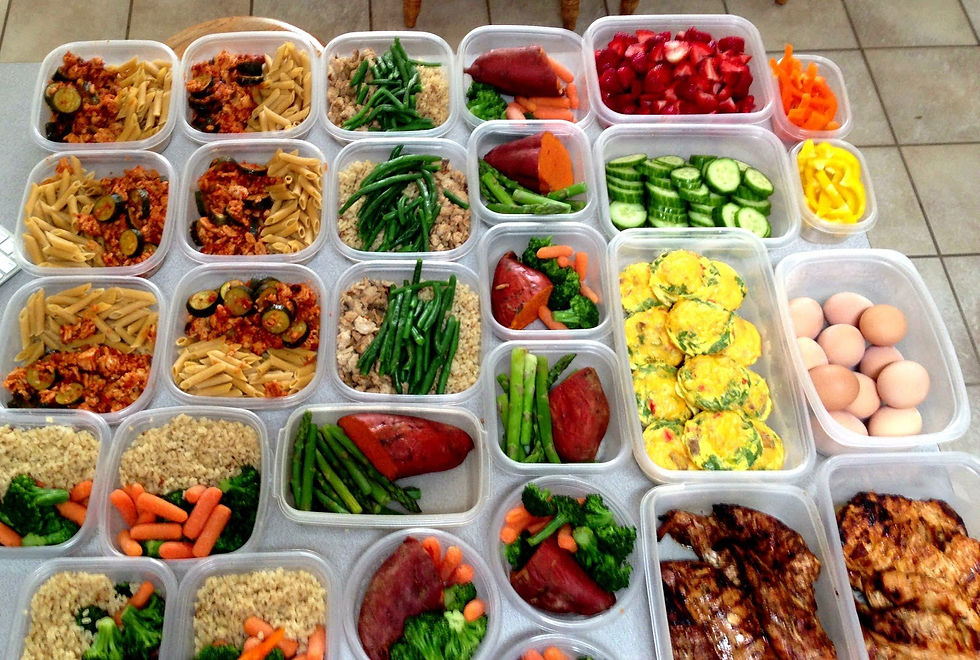
1. Choose your recipes.
The way I choose my recipes is pretty simple. I want all of my daily meals to include a balanced amount of protein, vegetables, healthy fats, and complex and simple carbs. I include some protein with every meal. I like making sides out of my carbs, but that’s not a rule, I could make a beef stew with potatoes and that would be awesome. I also think about my entire day. Where will the healthy fat come from? If I’ll be having oatmeal for breakfast some days, do I havehemp seeds or walnuts to put on top? I want to make sure I’ve got avocados on hand to put on my soup, and plenty of whole eggs.
2. Make a grocery list based on the recipes, and don’t forget the other things you’ll need to pick up!
So this part is pretty easy. Just pick the recipes you’re going to make, decide if you’re going to double them or make the amount it calls for and start writing your grocery list based on the foods you’ll need. Additionally, you’ll want to think about the meals and foods you won’t prep in advance, and can have on the fly. For example, toppings for your oatmeal and add-ins to your smoothies. Maybe you want some canned tuna or beans on hand that you can mash together with avocado for a quick and delicious snack or meal (for you, not me. haha). I always make sure I have some frozen meat and frozen vegetables in the freezer too, because I tend to eat out on the weekend, and don’t stick to a schedule.
Having things on hand that won’t go bad is super important. Being mindful of my nutrient intake throughout the day is why I always have my Shakeology on hand – to make sure I’ve got a good quick shake I can pound on the go, usually with a piece of fruit and some almond milk.
3. Set aside some time to enjoy your grocery shopping trip.
This is really important. Enjoy shopping – you’re an urban hunter-gatherer I like to get my groceries on a day that I have time to putter around the grocery store… This is actually the story behind why I started teaching cooking classes at Whole Foods… I would walk around the store doing my shopping, talking to the store employees about the food. Most of the people who work there really like the company they work for, and know a lot about the businesses they buy from and will take the time to talk to you about it…this is even more fun at a Farmer’s market! I’m endlessly curious.
4. Food prep!
When you get home, having the recipes is your blueprint to doing this successfully. Sometimes it takes a couple hours to put everything together. In fact, if you are doing it right, it always takes a couple to a few hours! But think about it – you’re batching your time. While doing food prep can seem time consuming, I find it extremely efficient and it saves me a ton of time during the week (and money – because you’re not nickel and diming yourself on lunches out, snacks, take-out food, etc). Not to mention it absolutely ensures I’m going to be making the best choices for my body all week and not relying on pre-made foods that have too much sugar, have additives or ingredients that might not be optimal for my health, can upset my hormone equilibrium and compromise my immune system. That’s the real cost of eating foods you don’t make…so when good food seems expensive, I think about how much I’m saving on health care and how fit and healthy I’m going to be in my 60’s, 70’s and 80’s as a result of my choices now.
It is not always seamless, and I don’t do it every single week, but I do my best to do food prep 2-3 times a month – and like I said, I always consider this a labor of love. For myself, my body – and if you have a family and you’re the one doing the food preparation, this is the ultimate act of love. Nourishing your family is a special and important job in any family – remember that. You’re setting a great example for your kids.
5. The right way to eat
Many people get really stuck at this point and bogged down in some of the most common questions. How much am I supposed to eat? What about my pre-and post-workout? I can’t eat too close to bedtime, so can I eat after an evening workout? How many calories am I supposed to eat? Here’s the secret to my success. There is noone-size fits all diet for everyone. Even if you have a calorie count in mind, it’s not going to be right or accurate for you every day, every meal.
A calorie doesn’t tell you the nutrient density in a food – it only tells you how many units of energy are in it. If a popsicle had the same calories as a pumpkin protein muffin, would that be a good thing to substitute? You wouldn’t give your body nearly as many nutrients, and you’d have to filter and process all the sugar – and lose the fiber, potassium and other awesome nutrients.
Your body knows that it’s full because of volume (how much you ate) or nutrient density (the nutrients in the food you ate).
You know how you just can’t stop eating certain foods until your stomach literally starts to hurt? This is why. You aren’t getting the nutrients you need, so your body just doesn’t feel “full” or satisfied until your gut is literally stretching. Many people shy away from whole foods that contain fat and carbs because they’re fearful of gaining weight – opting instead for some processed version of them. But those processed and pre made foods create all kinds of long-term problems in our bodies – insulin resistance, sugar spikes, fat storage, toxicity and the myriad of precursors to major disease and health problems. Our lean ancestors didn’t have “reduced fat butter” or “low fat yogurt” or “carb free bread.”
Counting calories totally sucks!
You miss the enjoyment of eating and cooking when you’re constantly tracking your calories. I’ll be the first to agree that having this experience is an important part of the learning process. Understanding the composition of different foods is extremely helpful. But don’t let it become a crutch and catch yourself limiting your food intake, obsessing over what you eat and skimping on whole foods because they have “too many calories.”
Pre and post workout, you need carbs and protein. But if you look at your meals, you’ve got protein and complex carbs in abundance – why not eat one of your meals that you’ve taken the time to prepare? And there is nothing wrong with a protein shake and some fruit, it’s fast, convenient and super portable, just be sure you’re using good quality protein powder and not relying just on shakes or bars. That’s a multi-billion dollar industry that’s done a killer job of making us think their packaged foods are better than the whole foods they’re imitating.
If you exercise at night, it’s important to eat some complex carbs (and protein and greens) after your workout – it is uncomfortable to go to bed on a full stomach so try not to eat right before bed, but you’re not going to get fat because you ate quinoa at 8:30 pm!
My approach isn’t going to be right for everyone, but I would be remiss to not share what has been tried and proven to work successfully for the long term for SO many people. It’s okay if not all the information I’m sharing here agrees with you. But for those of you who are tired of constantly eliminating food, worrying about how much you’re supposed to eat and wondering why you’re not seeing your waistline shrink this is the most important information I can give you.
You’ve got to adopt a lifestyle and habits that you can stick to for the long term.
Because consistency is the key to success – and to be consistent, you need habits you can sustain. Habits that support your body and its metabolic processes, that keep you on an even keel and constantly moving forward.
Eat real foods. Eat a variety of them. Include protein with your meals. Eat complex carbs in the morning and around your workouts, and eat lots of vegetables, fruit and greens. Don’t avoid fats. Stop eating when you are full. Eat when you are hungry. Let your food taste good! Respect your body, don’t starve it, don’t beat it up with chemicals and junk food.
Author: Betty Rocker


Comments